

Build your sales engine for predictable, scaleable revenue.
How to bring a GTM strategy to life, scale revenue, and empower your organization? For you as a leader it is your duty to equip your teams with an effective playbook, efficient sales enablement, performance oriented coaching and the right performance measures.
I think the sales operating model (SOM) is of such high importance for your success. That´s why my SOM framework consist of multiple tactical playbooks and frameworks to deliver a holistic approach which I adjust to your individual needs. It basically includes:
-
The playbook for your team: this playbook bridges your GTM strategy to real live operations of your team. It includes normally:
-
Buyer Journey and Sales Process
-
Lead Management Guide
-
Opportunity Management Guide
-
Account Management/Customer Success Guide
-
-
The leadership playbook: This playbook ankers your effective leadership, supports your decision making and ensures you are in line with your mandates. It includes normally:
-
Hiring Formula and onboarding procedure
-
Organizational Design
-
Empowerment Model
-
FLM leadership development program
-
Sales contests and experiments
-
Compensation Plan
-
-
The Sales Management playbook: This playboook defines your success map and builds your performance measurement with a focus on input driven KPIs. It includes normally:
-
Your individual Success Map
-
Input Metric design
-
Pull trough model
-
OKR definition
-
Reporting and forecasting
-
Strategy itself don´t change anything. Methods and Mechanisms do!
There are three aspects of a well-designed sales methodology:
-
The buyer´s journey
-
The sales process
-
The qualification matrix
Good you made a great GTM plan with a clear ICP, CVP, DMU, Buyer´s Journey and Sales Process definition!
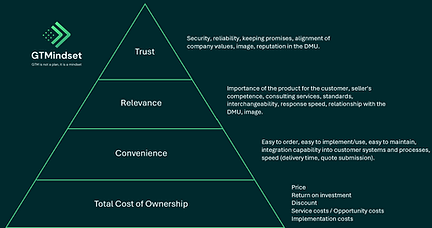
If not, you should do it now before your start with your SOM. The methods and mechanisms you have to install will be comletely different whether you sell to e.g. horizontal SMBs or vertical Enterprise business. But one thing will be true no matter where you sell to. You need your RIGHT TO PLAY. You need to be relevant for your customers. This means your sales reps. have to understand their customers. In more complex sales cycles they have to be a genuine consultant and trusted advisor to potential customers.
This requires that the salesperson truly understands the day-to-day job of the buyer. What do they do all day? What is easy, what is hard? What they are struggling with, challenges? What causes stress? What do their bosses want from them? How is success measured for them? AND they need to be able to reframe their situations and challenges. But more about the Challenger Sale later when we talk about your hiring formula.
So we ensured your buyer´s journey is understood and in line with your sales process. What´s next. Decide for a qualification matrix.
Demand Generation and Lead Management
Now, you are hoping for leads? Don´t wait for it. Build lead generation in your playbook. What are your channels that work for you? If you want to scale you should build an inbound lead machine! Ensure a constant flow of valuable content (blogs, ebooks, webinars, podcasts etc.) and help your sales reps to build their personal brand in social media. Implement agentic AI to support within this process and increase efficiency. Ensure your inbound lead process - again - is "from customer to product", which means don´t pass all leads to sales, implement an MQL filter. Different to an outbound process not every lead who has a pain is a good fit.

The outbound prospecting guide should define if your are using an Account Based Selling (ABS) tactic or more transactional focused cold calling, e.g. on inbound leads. Especially when you want to sell big deals to enterprises the prospecting process needs an ABS approach and a differentiated buyer persona outreach.
Your playbook should define when you transfer leads to Sales (MQL), how to do prospecting and lead discovering and which leads you prioritize. Additional helps your reps with clear sales messaging for each Lead-to-Opp. phase, outreaching tactics, content enrichment and CRM implementations. Sounds a lot of work? GTMindset partners with you to deliver an individual sales playbook ensuring the right outreach approach with every buyer awareness stage.
Opportunity Management - Scrap company presentation
An opportunity process should be driven by actions of your sales reps. but activities of the buyer persona.
-
Did the buyer confirm the summary of the discovery call was accurate?
-
Did the buyer open the proposal?
-
Did a VP- or C-Level executive attend the product overview?
-
Has someone in finance reviewed the ROI study given by the salesperson?
Especially when you participate in complex sales environments with long sales cycles, opportunity management can be very challenging but key for market success.
You need strategic acting account executives or account managers to evaluate the right champions, understand the different CVPs (customer value propositions) of different buying personas in the DMU (decision making unit), qualify the opportunity by more complex qualification matrices like MEDDIC, be able to transfer the investigated customer needs in a reframing concept presentation, hold individual DEMOs, sell pilots for a PoC (proof of concept) and be confortable to talk about pricing and contracting.

Sounds complex? Don´t let your reps. alone and support them with a helpful playbook and technological enablement for:
-
Content Enrichment and Account Research Tools
-
Pitches and Concept Presentations
-
Customer Value Propositions
-
Hypothesis and White Spacing
-
Qualification Matrices
-
Pay-off Calculation Tools
-
Frame Contracts
-
Cross-functional Collaboration, e.g. Pre-Sales
An effective opportunity management process will improve your pipeline velocity, WinRate, customer retentention, customer acquisition costs, signings etc. In short: It lifts your sales excellence on another level. GTMindset supports you with our sales excellence expertise and market insights to build your opportunity management playbooka nkered in your CRM process.
Customer Success: Cross-funtional collaboration really matters
Customer Success actually starts with your solution concept in your pre-sales phase. No matter if you sell more transactional or if you are using a consultative selling approach, no matter if your business model focuses on one-off payments, subscriptions or performance based contracting - you want your customers to be sastisfied, you want your customers to use your solution to solve their problem.
No secret that the handover from pre-sales to post-sales causes big friction. Not just for the customer but also within your revenue organization. The major mistake I could investigate in the market: the usage of too much standardizing in the implementation process.

While we try to be as much customer centric as possible during the sales process, a one-size fits all project implementation by your customer success or project implementation team ignors the unique context uncovered during during your opportunity management phase. Few things frustrate a customer more than realizing that the customized solution is handed off to a separate, highly independent post-sales team that fails to maintain the same customer-centric experience delivered during the sales process.
What you need to drive your excellence in this process is cross-funtional collaboration, starting in your conception phase. Especially in complex sales cycles where your most probably sell to a buying center - you need a selling center as well. Have a playbook in place where your pre-sales team, implementation team or customer success team gets involved within the customer concept and takes over the lead after contracting. This will not just improve your customer retention it will increase your WinRate. Why? As it will build trust at your customer when the responsible people for the implementation have been visibly involved during the conception phase.
As it will be impossible to be fully customized for your implementation as well as it might be not very clever to leave your customer success team without a playbook, we recommend to prepare 3-5 implementation scenarios to align best with the use cases and unique context of your customers.
Hire for WHY, organize process driven and onboard with system
We do better in cultures in which we have a good value-fit. So hire for people who believe in and are passionate for your purpose. Don´t hire skilled people and motivate them. Go for self-disciplend, value driven people first. Great leaders hire motivated people, inspire them and give them something to work towards.
But how do you find those talents?
Find out more in my blog post or contact me directly.

Empowerment Model - Enablement, Performance Management, Innovation, Coaching (EPIC)
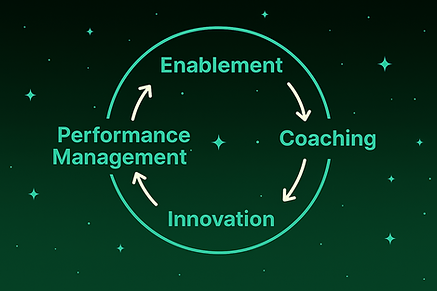
The core of your leadership playbook will be your empowerment model. In sales organizations, empowerment is a buzzword that often gets reduced to "coaching." Coaching is vital. But true operational empowerment goes far beyond motivational talks or isolated training sessions.
As a Revenue Leader in a growth environment, you carry the responsibility to enable your teams consistently and in real-time. That means providing them not only with inspiration but also with actionable tools: templates, playbooks, workflows, technological integrations, and fresh market insights.
Your Success Map - A deep dive in what drives your success
The key for the management system is to focus on input and activity based metrics. This means we manage our inputs not our outputs. Companies in general, have very little ability to directly control output metrics. What´s really important is to focus on the “controllable input metrics”, the activities you directly control, which ultimately affect output metrics such as revenue. This means you have to find out which are the drivers of your business, which will, when managed well, lead to increase of profitable growth.
Why I focus on input metrics:
-
You can actively manage. Sales people act in their circle of influence.
-
You work on the root cause.
-
You see signals earlier.
Defining a success map has proven to be a very powerful tool to drive high performing teams and implement leading indicators which help you to manage your teams agile and in-time in the right direction. I have built strong expertise in this systematic to support in building your success map and focussing on effective input metrics which really drive your outcome. Find our more about how to map your success and effectively focusing on your business driver in my blog post.
