
Leading with principles and effective leadership habits

Updated: Jun 20, 2025
To practice autonomy and become a self-driven leader it is important to clarify your principles and individual mission statement. As leadership is based on expectations and individual needs your principles should build the base for your leadership.
I have defined my principles on which I build my leadership.

Update your leadership habits
You can be never too busy to sharpen your saw! No fuel no drive.
Practice intrinsic security which means have accurate paradigms and correct principles plus practice service e.g. within your community. Try to work from the inside out and be the transition person in your organization. A transition person stops bad habits and scrips others by giving them a positive reflection. Use your imagination and treat people in terms of their potential. Don´t make the easy mistake to write-off people too early no matter what other people (e.g. your manager) will tell you from history.
As Goethe said: “Treat a man as he is and he will remain as he is. Treat him as he could and should be and he will become as he can and should be”
For sure this might not be valid for all people and we will later see that it is almost impossible and senseless to spend too much time in motivating people who are intrinsically demotivated. Nevertheless, here we are talking about “leading yourself” and not “leading others”!
Plan 1h a day to sharpen your saw and manager your energy level with physical, mental and spiritual exercise. Additionally, take care of your social and emotional relationships with yourself and others. Life is about relations to other and a fluid character. I will talk more about that in my blog post about managing change and develop a flexible mindset for change. So stay tuned.

To be a strong leader it is essential that people trust you. Therefore, you need to build credibility.
Besides those dimensions of the sharpen the saw you have to set the daily focus on four key drivers of your personal operating model:
Priorities: Setting the Right Focus
Understand your mandates: Know what key stakeholders expect and align priorities accordingly.
Prepare for critical conversations: Identify the most important discussions and strategize for maximum impact.
Quite low-impact work: Focus on a few, bold initiatives rather than spreading too thin.
Role: Focusing on What Only You Can Do
Maximize unique strengths: Leaders should personally drive projects that need their influence.
Delegate effectively: Empower the right people and ensure they have clear expectations.
Build strong support systems: Surround yourself with a reliable team (assistants, chiefs of staff, or advisors).
Time: Managing with Discipline and Flexibility
Set boundaries: Establish limits on availability, meeting participation, and focus time.
Create an intentional schedule: Structure time around business rhythms, performance cycles, and personal well-being.
Redesign meetings: Ensure meetings serve a clear purpose, involve the right people, and drive outcomes efficiently.
Energy: Sustaining Peak Performance
Prioritize health: Maintain sleep, nutrition, and exercise to manage stress and sustain long-term leadership effectiveness.
Invest in real relationships: Build strong personal and professional networks to stay grounded and supported.
Find purpose: Align work with meaningful goals to stay motivated and engaged.
To achieve this continuous renewal and become a self-driven, proactive leader that inspires for a vision it is important to establish the correct habits. I will follow and coach the habits given in the 7 habits of highly effective people to win the private victory.
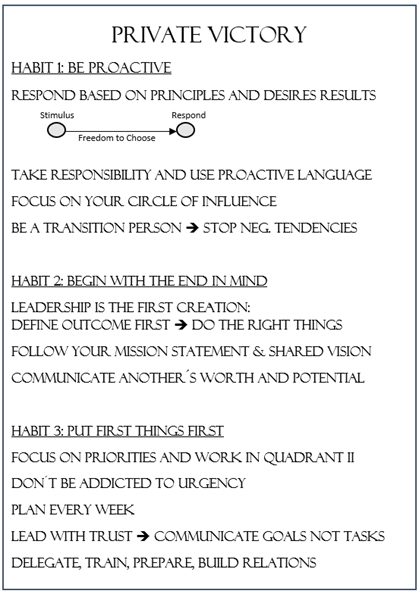
Habit 1: Be Proactive
To be proactive basically means that you should be an agent and not a victim of what happens to you. Take the initiative and responsibility for your live! What´s said easily turns out to be very hard. Nevertheless, it is that easy: focus on what you can do (your circle of influence), do your best, accept reality how it is, don´t put false expectations on yourself and come out the other side.

The Circle of Influence Reactive vs. proactive people make choices based on their impulse. And like a can of soda, they explode when pressure gets high. A proactive person make choices based on values and principles. They think before they act. Like still water, they might seem lame once in a while compared to the soda-person, but when they get shaken, they calm down again. They do understand one very important thing: There is a box between stimulus and their reaction - their freedom to choose based on:
Self-awareness (observe what you like and what not)
Conscience (discern write and wrong)
Imagination (envision new possibilities)
Independent will (act outside of other influences)
It´s all about having the right mindset for growth. If you are interested in becoming a proactive person, contact me for a 30-day-test of proactivity.
Begin with the end in mind
To topic I focus most on my leadership with my teams is coaching them in effectiveness vs. efficiency. Think before you act! Effectiveness = doing the right things Efficiency = doing the things right So, before you climb up the ladder as quick and secure as you can, you should ensure that you have lend the ladder against the right wall. The framework of GTMindset differs between leadership and management Leadership. Do the right things is a topic of leadership. Do the things right is management. But therefore, it is necessary to be clear about the things you want to accomplish as an individual or with your team. Here it can help to take the time and write down your mission statement or even come together as a team and write down a team mission statement. It about scripting your inner core: your paradigms. Contact me if you need a third person steering a workshop to help you creating your individual or team mission statement. One thing I experienced myself and have observed a lot at others is, when experts or managers are promoted to a leadership position they very often simply focused on the analytical skills. Means: they only working with their left (logical and verbal) half of the brain. But leadership is not just about analysis it is rather about synthesis, about putting things together. Here, you need to make use of your right (intuitive, creative) half of your brain. Especially in common B2B companies leaders struggle more to work with their right half. If so, you can make use of visualizations and affirmations to enter your right half. And don´t forget to visualize the growth of your team members as well. Communicate frequently their worth and potential, so they are inspired to see themselves.
Put first things first
Things which matter most must never be on the mercy of things which matter last. For me the most important in live is my family. My lovely spouse and wonderful kids. My parents and sisters, the parents and siblings of my wife. In general, "putting first things first" is bringing to reality what you have imagined and defined in habit 2. Effectiveness leads; efficiency follows.
You might have been to workshops and training where they trained you to manage your time and focus on things. But this sets a false perspective. Rather focus on preserving and enhancing relationships and on accomplishing results, not topics. Most probably you have heard about the Eisenhower Decision Matrix of urgent vs. important. Following you can see an example of such matrix showing you where to put most of your time as a leader: in Quadrant II

Eisenhower Matrix - Important vs. Urgent If you work in QII you work strategically. To ensure you don´t get overrun in your daily chaos by urgency, take 30min every Friday and plan your upcoming week and the rolling month. With this method you can ensure that urgent topics will be put around the important topics even if they are not urgent, at the moment.
Last but not least Habit 3 teaches you to lead with trust. As trust is the highest form of human motivation. We will deep dive in the leading with trust within the post as it is so important.
Leading with trust starts by communicating goals and not tasks to your team. Instead make people accountable for their results and give them the freedom to choose the methods. EMPOWER your people. I will deep dive in the topic of EMPOWERMENT on daily tactical base in my post about the GTMindset empowerment model. A first glance: Operation
So in summary the first three habits of the 7 Habits of Highly Effective People can seen as:
Habit 1: Build the right leadership principles

Habit 2: Build the first creation - Leadership
Habit 3: Realize the creation - Management
Trust
To create self-trust which will build your credibility in the organization you have to grow in the 4 cores of:
integrity
intention
capability
results.
My leadership coaching helps to create your credibility and make use of the speed of trust built on the research of Stephan M. R. Covey, the son of Stephen Covey, writer of the 7-habits.

To create self-trust which will build your credibility in the organization you have to grow in the 4 cores of integrity, intention, capability and results.
Focus Core 1 – Integrity: honest, congruent, humble, courageous
„I look for three things in hiring people – integrity, intelligence, high energy level. But if first is not given the other two will kill you” _Warren Buffet
!Rules cannot take the place of character!
3 accelerators for integrity
1. Make and keep commitments to yourself (don´t make them impulsively)
2. Stand for something
3. Be open
Focus Core 2 – Intent: motive, agenda, behavior
“We judge ourself by intent but others by their behavior” _Stephen Covey
Our motives and agendas are deep inside our own hearts. But they become visible to others by our behaviors and as we share them with others.
The motive that inspires the greatest trust in genuine caring
The agenda that inspires the greatest trust in seeking mutual benefit
The behavior that inspires greatest trust is acting in the best interest of others
Caring about the few has an impact on the whole
3 accelerators for intent
1. Examine and refine your motives. E.g. adaption of 5whys, role models, mental/spiritual daily diet etc.
2. Declare your intent with e.g. customers. Let them know why you are doing what you do. Why do you share your strengths and result è to gain their confidence! Tell you want to build trust
3. Choose abundance
Focus Core 3 – Capabilities: Competence inspires confidence
!If you are not relevant, you will not have credibility!
TASKS:
· T = Talents è unique strengths and talents è coming naturally
· A = Attitudes è e.g. “I have to work” vs. “I´m excited to go to work”
· S = Skills è try to align your (developing) skills with your talents and passion
· K = Knowledge è What do you do to stay current?
· S = Style è How effective do you approach problems and people?
Many people are not into the idea of continuous improvement. So, they worked for 15 years for a company. But instead of having 15 years of experience they have only 1 year of experience repeated 15times!
3 accelerators for capabilities:
1. Run with your strengths (and with your purpose) è and work effectively with others who compensate for your weaknesses
2. Keep yourself relevant è be a lifelong and continuous learner
3. Know where you´re going è “at the end of the day people follow those who know where they´re going”
Focus Core 4 – Results: What´s your track record? Results matter!
You may have excuses; you may have good reasons. But at the end of the day if the results aren´t there neither there is credibility. It´s that simple! It´s that harsh!
Performance-Value-Matrix: getting results vs. living the values
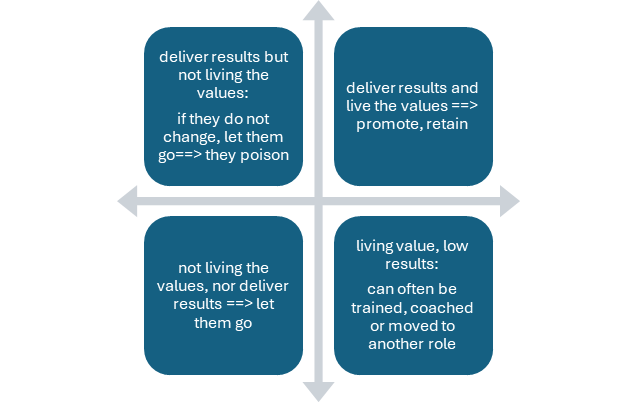
Results cannot always be measured in dollars or profit è define your results clearly and think strategically
A transparent culture of learning and growing will on the long run create results è Trust
Appreciate and see the importance of support roles for results
People “must” be aware of the results. Otherwise, they are useless
3 accelerators for results:
1. Take responsibility for results è not just for activities! E.g. “I called the customer” vs. “I made the deal” Result focus is a different mentality than activity focus. è Even if the results are not good. When you take responsibility, it will create trust
2. Expect to win è plain faith, positive self-expectancy. We get what we expect. Be confident in you and others
3. Finish strong
If you find out more about leadership principles and how to define your private mission statement as your fundamental compass for effective leadership and personal development feel free to contact me for your first free leadership coaching discovery call.
If you want dive deep in the leadership of teams and building external trust with your stakeholders and markets, follow my upcoming post or reach out directly. Contact

Comments